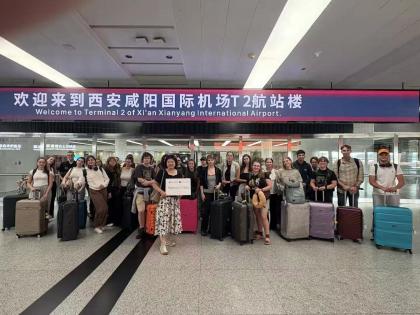
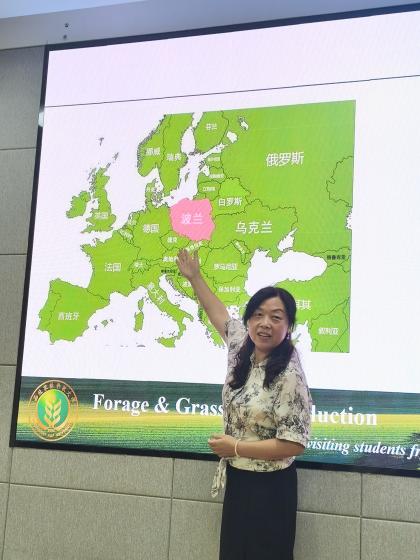
Students from the Faculty of Agriculture, Horticulture and Biotechnology in a summer school in China
The summer school at Northwest A&F University provided students from the Faculty of Agriculture, Horticulture and Biotechnology with an opportunity not only to get to know one of the world’s leading agricultural universities, but also to experience first-hand the Chinese campus, laboratories, agriculture and the everyday students life.
We were hosted by Northwest A&F University, situated in the Yangling academic and research centre, also known as the ‘agricultural Silicon Valley’. Around 30,000 people study at the university, and for a month we had the opportunity to become part of this academic community.
The university consists of colleges, which are comparable to our faculties. We were affiliated with the College of Grassland Agriculture. The campus is divided into two large sections – north and south – which are about two kilometres apart. Just hour away from Yangling lies Xi’an – one of China’s ancient capitals, known worldwide for the Terracotta Army. The ancient Silk Road also ran through this region. This route provided access to China not only for goods, but also for crops, including alfalfa originating from Western Asia.
The campus itself was also full of surprising contrasts. There were palm trees growing everywhere, pomegranate trees lined the streets, and September announced the season for the kiwi fruit harvest. This area is one of the most important regions for kiwi fruit production in China.
The campus of the future
We quickly got used to the technology that is part of everyday life in China during our stay. One of the most obvious examples was facial recognition systems. To enter the campus, students passed through gates that opened after their faces had been scanned. In our case, this system did not work at first, so the gatekeeper had to open the gate for us manually. Facial recognition was also used for payments and to confirm attendance at work. We mostly paid by mobile via WeChat and Alipay. In many places, all we had to do was scan a QR code or display our own code in the app. We hardly needed any cash at all.
Chinese cuisine from breakfast onwards
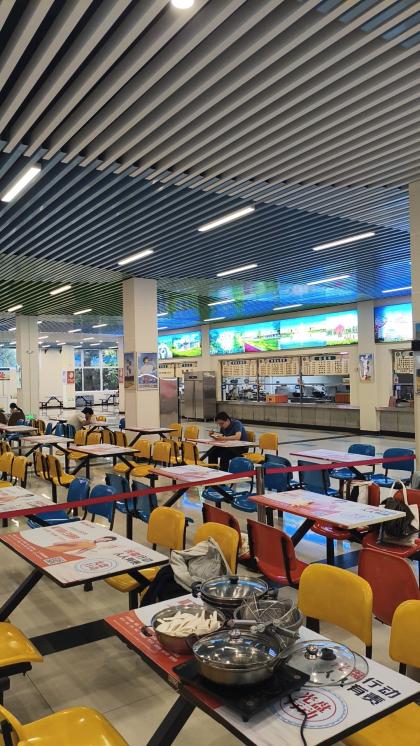
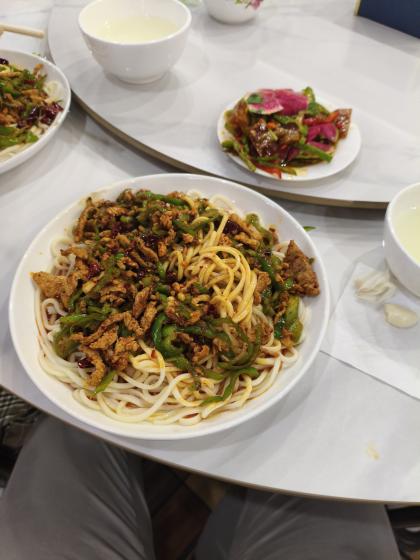
Getting to know Chinese cuisine was a wonderful experience. The university canteens were like extensive food courts – several large buildings housing numerous food outlets. In each one, you could order something different: dumplings, noodles, rice, soups or meals with vegetables and meat. Students living in halls of residence are not allowed to cook there, which is why canteens are an important part of campus life. People also go there for breakfast. Options include baozi – steamed buns, jiaozi – Chinese dumplings, zhou – rice porridge, as well as the iconic tea eggs. These are hard-boiled eggs, the shells of which are lightly cracked and then boiled again in a stock made from tea, soya sauce and spices. And using chopsticks quickly became a part of our daily routine.
Electric scooters and silent streets
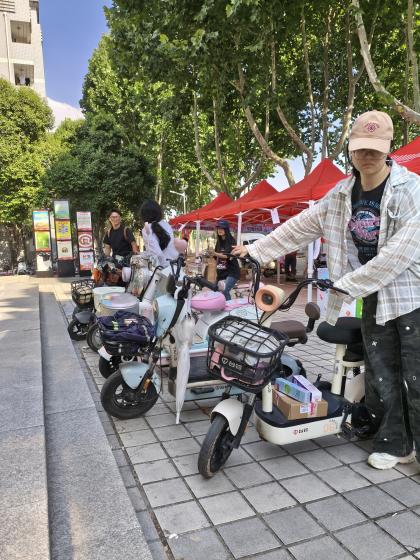
The campus was so spacious that it took about 15 minutes to walk from the gate to the canteen. No wonder, then, that the vast majority of students get around on electric scooters and mopeds. With tens of thousands of students, there were even occasional scooter traffic jams. At the same time, the streets were noticeably quieter than in Poland. In Yangling, the large number of small vehicles were electric. Even vehicles resembling traditional tuk-tuks, despite sometimes looking rather old, were often electrically powered.
The wine that hides underground in winter
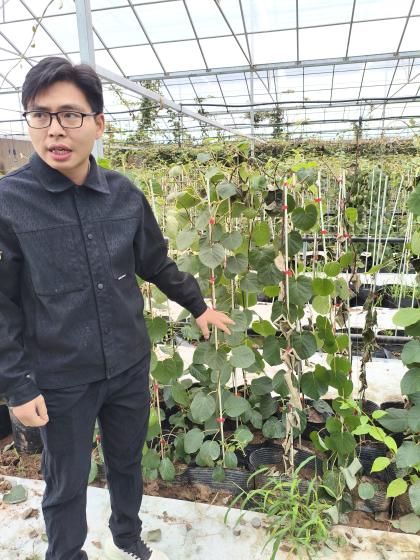
The university also offers courses in oenology. Wine production in China is growing rapidly, although it requires special care in the cooler northern regions. In autumn, the grapes are removed from their support structures, bent down to the ground and covered with a layer of soil to protect them and the buds from severe frosts. In spring, the plants are uncovered and trained back onto their supports. This perfectly illustrates just how much cultivation techniques must be adapted to the continental climate of northern China.
The Chinese-style of student life
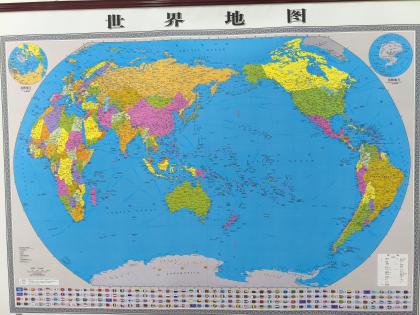
The academic year began whilst we were there, in the first half of September. We were able to observe the arrival of the new students. Many of them were dropped off on campus by their parents, who were celebrating their daughters’ and sons’ success – gaining a place at one of the country’s top universities. Distances in China are on a completely different scale to those in Poland. Students often come from places over a thousand kilometres away and return to their family homes only once or twice a year. The university has bells that signal the start and end of classes. There is also a clear distinction between undergraduate and postgraduate studies. Students at more advanced stages of their studies devote a large part of their time to research and preparing their dissertations. Undergraduates, postgraduates and academic staff all work very intensively, often late into the night, and some laboratories operate practically round the clock.
The kindness that goes beyond language barrier
We were treated with immense warmth and kindness. And we felt very well-cared for, and at times even like celebrities. Strangers we met by chance, particularly in smaller towns, were keen to take photos with us and strike up a conversation. Modern technology and artificial intelligence were a huge help. Our mobile phone allowed us to translate text from photos, whilst automatic speech translation enabled us to converse despite the language barrier. It was also used for payments, ordering DiDi – the Chinese equivalent of Uber – using maps and communicating. Managing without a mobile phone in today’s China would be really difficult.
And it is not just about the university
During this trip, we also found some time to explore nature and culture. We were especially impressed by the pandas, whose somewhat clumsy movements really did remind us of scenes from the ‘Kung Fu Panda’ movie. We also visited Xi’an and the famous Terracotta Army. As a result, the trip had not only an academic and educational dimension, but also a cultural one. Most importantly, however, we were able to experience everyday life in China – not through a television screen, press reports or stereotypes, but first-hand through the university, the streets, the halls of residence, the laboratories and conversations with people. This travel allowed us to see the scale of the changes that have taken place in China over recent decades. Huge cities, well-developed infrastructure, electric vehicles, digital payments and substantial investment in science and education paint a picture of a country that is highly modern, yet deeply rooted in its history and traditions.
Stanisław Świtek PhD