Storks on the Move – From Tracking Technology to Protecting Bird Migration Routes
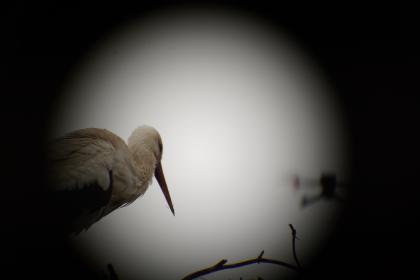
Is it possible to see the world from the perspective of a flying stork? Researchers from the Poznań University of Life Sciences prove that it is, and they are doing so in a way that could change the approach to protecting migratory birds. By attaching miniature cameras to the birds, the researchers have obtained for the first time a direct record of their journey across three continents.
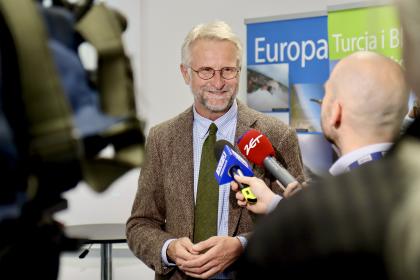
“This is one of the most advanced studies of bird migration in Europe,” says Prof. Piotr Tryjanowski of the Department of Zoology at Poznań University of Life Sciences. “Until now, humans have observed them from the ground. Now the perspective has been reversed.”
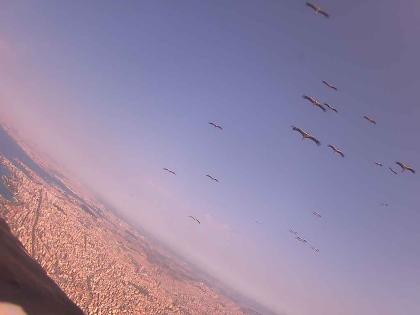
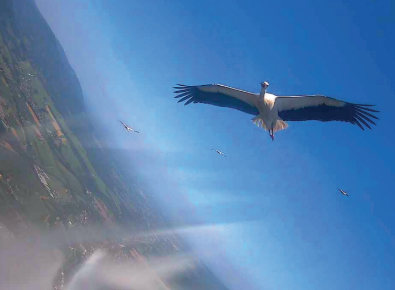
Polish ornithologists equipped storks with special “backpacks” containing miniature cameras that record video and audio from the bird’s perspective. The result? Unique footage showing migration from a completely new viewpoint, from Romania and Turkey, through Israel, all the way to Sudan and Tanzania. These are not only spectacular shots, but above all a scientific breakthrough.
“We are moving from tracking points on a map to a real-life picture of the environment in which the birds live,” emphasizes Prof. Łukasz Jankowiak of the University of Szczecin. “This is a qualitative change in migration research.”
Technology That Is Transforming Science
Cameras represent the next step beyond GPS transmitters, which have been used for years to track migration routes. Now, scientists not only know where storks are flying, but they can also see what challenges they face along the way.
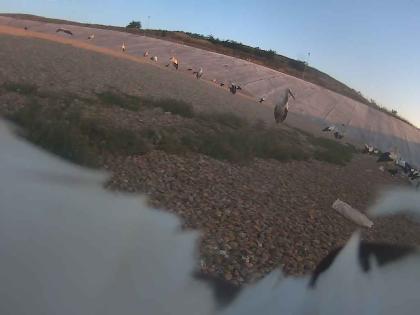
Geotagged photos and videos allow researchers to identify specific threats, ranging from collisions with power lines to changes in land use. The footage also reveals the growing extent to which storks are using landfills as a food source, marking a significant shift in their foraging strategy.
The Stork as an Indicator of Environmental Change
Research by a team led by Prof. Piotr Tryjanowski confirms that the white stork is an indicator species; its behavior reflects the state of the environment across a vast area of Europe and Africa. Data from southern Europe are particularly alarming, where rising temperatures and changing environmental conditions are reducing the birds’ survival rates.
As Joanna Białas, PhD and Marcin Tobołka, PhD from the Department of Zoology at the Poznań University of Life Sciences point out, the observed changes are not local but systemic in nature and reflect the scale of human-induced landscape transformations, which directly affect the course of migration and the survival chances of these birds.
The conclusion of the research is clear: it is impossible to effectively protect migratory species in a fragmented manner.
“Protecting a single site, even one as important as a breeding ground, is not enough,” emphasizes Prof. Piotr Tryjanowski. – Effective protection of the white stork must cover its entire migration route: from Europe, through stopover sites, all the way to wintering grounds in Africa. The collected data clearly indicate that locally undertaken actions, though important, do not yield the expected results without parallel protection of the entire migration route. The white stork thus becomes a symbol of the challenges facing modern nature conservation, which requires international cooperation, the integration of scientific data with modern technologies, and the involvement of various sectors of the economy.
Science and Business for Nature Conservation
The project is being carried out in collaboration with external partners, including the energy sector. EDP’s involvement helps us better identify infrastructure-related risks and develop future solutions to minimize its impact on birds.
The collected data forms one of the most comprehensive knowledge bases on white stork migration in Europe, combining years of field observations with modern technologies, big data analysis, and artificial intelligence tools.
The project from Poznań shows that the future of nature conservation lies in the integration of technology and science. And sometimes a breakthrough begins with a simple idea: to look at the world… through the eyes of a stork.
Report “Through the Eyes of a Stork” by Mateusz Majchrzycki, TVN24 https://www.youtube.com/watch?v=-WrGrXszVFE
Iwona Cieślik
PULS Press Officer